
Most website visitors form an opinion about a business within seconds of landing on the page, and that opinion is based almost entirely on design. Research shows that 94% of a visitor’s first impression of a website comes from its visual design, not its content. For a clothing store, the theme is what creates that impression. It is also what determines whether a visitor can find the right size, see a product clearly, and complete a purchase without frustration.
Choosing the right Shopify theme is not simply a matter of appearance. It affects how long visitors stay on the site, how easily they complete a purchase, and how well the store performs in search results. This guide explains what to look for in a clothing store theme, provides a detailed overview of the leading options, and recommends the right theme for different types of clothing businesses.
Contents
- 1 Key Takeaways
- 2 Why Your Shopify Theme Matters for Clothing Brands
- 3 Key Features Every Clothing Store Theme Should Include
- 4 Quick Glance of the Best Shopify Clothing Themes in 2026
- 5 Top Shopify Clothing Themes in 2026: Detailed Overview
- 6 Best Theme by Business Type
- 7 Free vs Paid Shopify Clothing Themes
- 8 How to Choose the Right Theme Based on Your Business Stage
- 9 Conclusion
Key Takeaways
- Studies indicate that 94% of a visitor’s first impression of a website comes from its visual design.
- A Shopify theme affects sales, mobile experience, and search engine rankings, not just appearance.
- The most useful clothing store themes include color swatches, size charts, mobile-friendly layouts, and fast loading speed.
- Free themes such as Dawn are a good starting point for new businesses; paid themes are better once a store is ready to grow.
- The right theme depends on business type: a boutique, a luxury label, and a large retailer each need different features.
- Reviewing a comparison table and testing live demos before purchase helps avoid costly mistakes.
Why Your Shopify Theme Matters for Clothing Brands
Clothing is one of the most visual product categories sold online. A customer cannot touch the fabric or try on the fit, so the theme has to do that work instead. Features such as zoom on product photos, clear color options, and accurate size charts help customers feel confident about a purchase.
A theme also affects two areas that go beyond appearance: mobile performance and page loading speed. A large share of clothing store visitors browse on their phones, and a slow-loading page causes many of them to leave before they see a single product. Page speed also affects Google rankings, since faster websites are generally favoured in search results. In simple terms, the theme a business chooses can directly affect both sales and visibility.
Key Features Every Clothing Store Theme Should Include
Before comparing individual themes, it helps to understand what separates a theme built for clothing stores from a generic one:
- Colour swatches with image matching: customers should see the product in the exact colour they select, instead of clicking through separate pages for each option.
- Size charts and clear stock status: reduces returns and hesitation. Sizes that are out of stock should be marked clearly so customers do not attempt to order them.
- Mobile-friendly design, not just a responsive layout: there is a real difference between a design that simply shrinks to fit a phone screen and one built specifically for mobile use, with easy scrolling and a simple checkout process.
- Fast loading speed: a slow theme can lower both sales and search engine rankings, regardless of how good it looks.
- Built-in sales features: tools such as a visible “Add to Cart” button, quick product previews, and an easy-to-use menu reduce the need for additional paid apps.
- Sections for photos and brand storytelling: layouts that allow a business to display styled outfits and brand imagery help customers connect with the product, not just view it.
Setting up these features correctly often requires some technical knowledge, particularly when customizing a theme beyond its default settings. Business owners who are short on time or unfamiliar with the process may find it useful to work with a Shopify Development Company in Calicut to have the store set up correctly from the start.
Quick Glance of the Best Shopify Clothing Themes in 2026
| Theme | Price | Type | Best Suited For |
|---|---|---|---|
| Dawn | Free | Free | New businesses testing an idea |
| Blum | $170 | Paid | Budget-conscious brands and print-on-demand stores |
| Mavon | $280 | Paid | Fashion stores with large or growing catalogues, including drop shipping |
| Retina | $220 | Paid | Mobile-focused clothing stores |
| Impulse | $400 | Paid | Stores that run frequent sales and promotions |
| Prestige | $400 | Paid | Luxury and high-end clothing brands |
| Avante | $290 | Paid | Boutique and women’s fashion stores |
| Motion | $400 | Paid | Streetwear and lifestyle brands |
| Reformation | $430 | Paid | Large retailers with high product volume |
| Zest | $330 | Paid | Mobile-first, direct-to-consumer brands |
(Prices reflect one-time theme cost. Additional apps may be required depending on business needs.)
Top Shopify Clothing Themes in 2026: Detailed Overview
Dawn
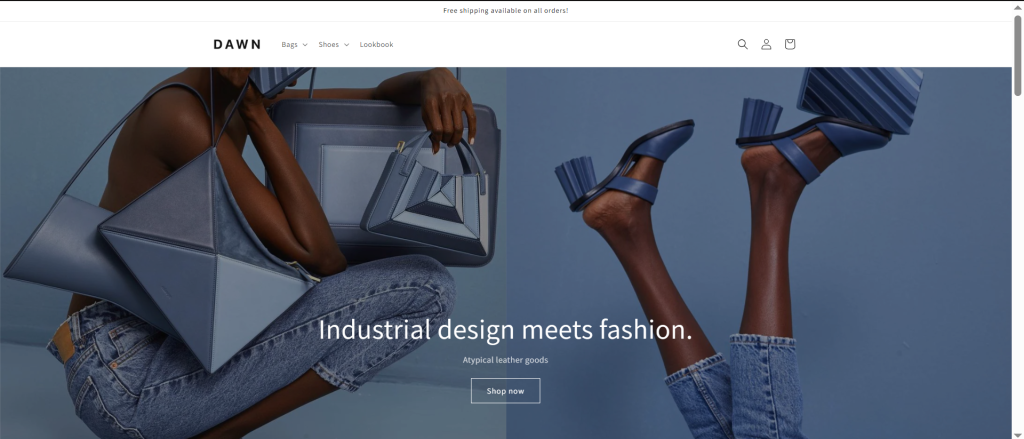
Dawn is Shopify’s built-in theme, designed as a clean, general starting point rather than one built specifically for fashion. It is best suited to new businesses that want to launch quickly and test demand before investing in a paid theme.
- Price: Free
- Key features: Basic colour and size variant options, clean minimal layout, fast base loading speed
- Design style: Simple and general-purpose; not built specifically for fashion
- Why it works: Lets a new business launch quickly with no upfront cost
- Considerations: No built-in quick buy, promotional banners, or advanced storytelling sections; expect to add apps as the store grows
Blum
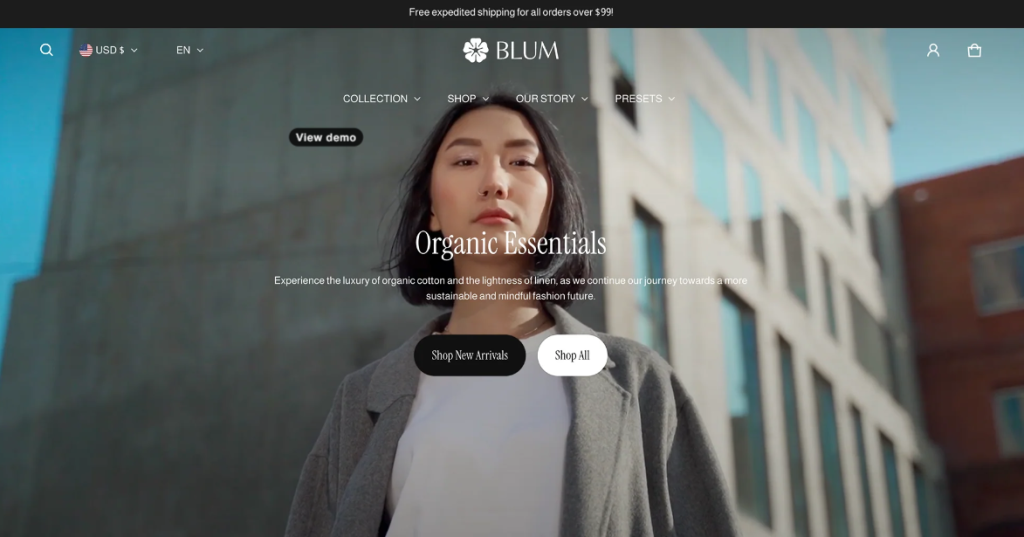
Blum is a fast-loading, mobile-first theme built for businesses that want strong core functionality without a high price tag. It is a practical option for cost-conscious brands, including print-on-demand stores that already rely on several other apps.
- Price: $170
- Key features: Colour swatches, size options, one of the faster loading speeds among paid themes
- Design style: Clean and mobile-first, minimal visual clutter
- Why it works: Print-on-demand stores often already run several apps for order fulfilment; a lightweight, fast theme avoids adding further slowdown
- Considerations: Fewer storytelling or editorial sections than premium themes, so branding relies more on product design
Mavon
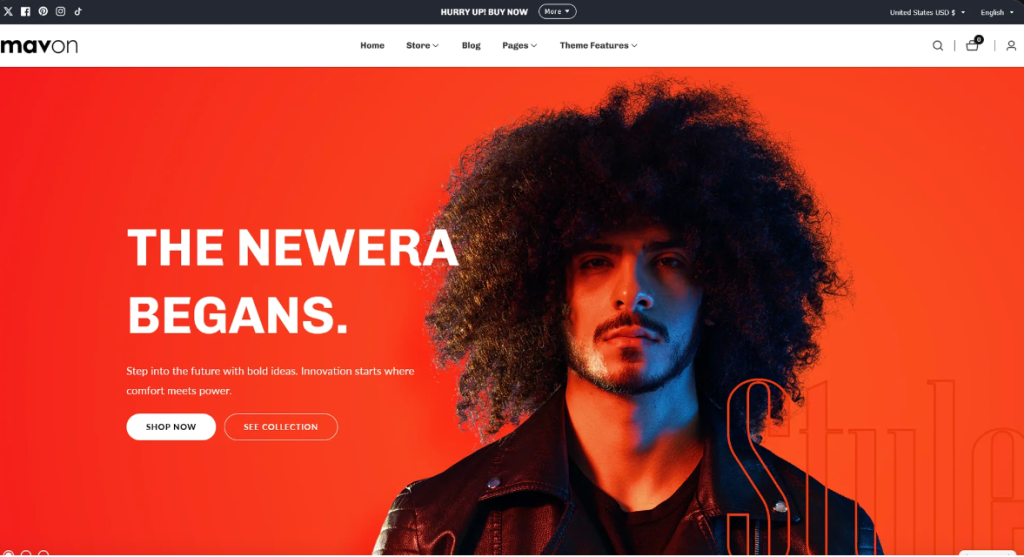
Mavon is developed for fashion brands directly, with Shopify’s own store describing it as a boutique theme built for clothing and accessories. It is particularly suited to stores with a large or growing catalogue, including dropshipping businesses that need to manage stock across many products.
- Price: $280
- Key features: Mega menu, sticky header, countdown timers, stock counters, colour swatches, and more than 20 customizable sections
- Design style: Modern and boutique-style, purpose-built for fashion rather than adapted from a general template
- Why it works: Combines fashion-specific design with features suited to managing a larger or frequently changing catalogue, including built-in urgency tools such as countdown timers
- Considerations: Mid-to-premium pricing; brands with a very small catalogue may not need its large-catalogue management tools
Retina
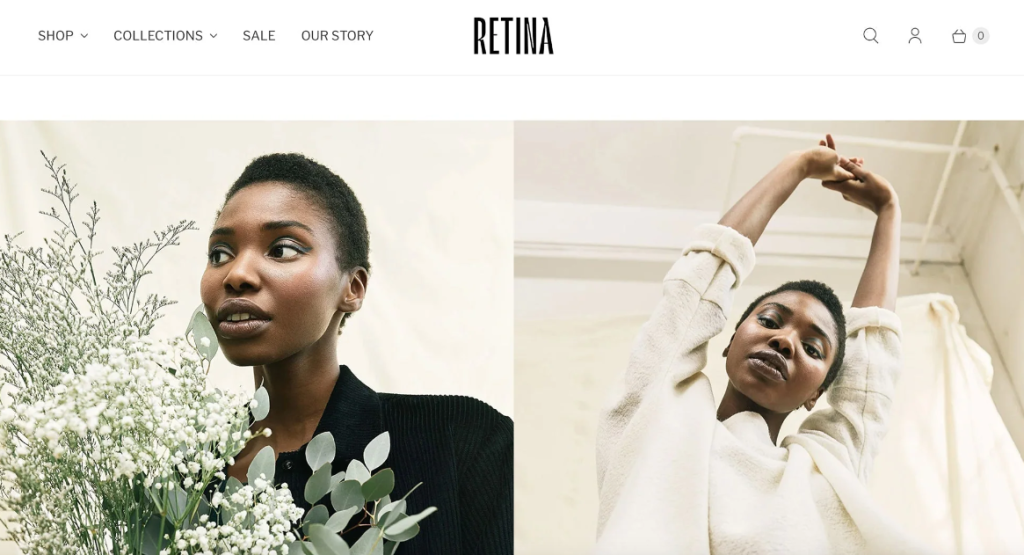
Retina is built with mobile shoppers in mind, making it a reasonable option for stores where most customers browse and buy from their phones. It sits in the mid-range price bracket, balancing cost against mobile performance.
- Price: $220
- Key features: Back-in-stock alerts, promotional banners, mobile-optimised browsing
- Design style: Practical and mobile-oriented rather than heavily editorial
- Why it works: A reasonable mid-range option for stores that need mobile performance without paying premium pricing
- Considerations: Fewer high-end storytelling sections than Prestige or Avante
Impulse
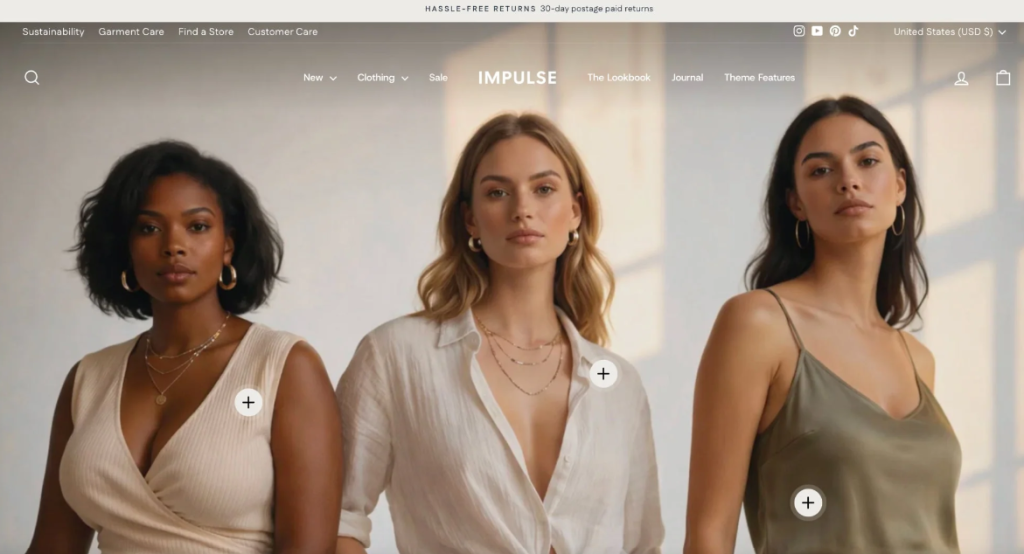
Impulse is designed around urgency, helping stores that run frequent sales and promotional campaigns convert visitors quickly. It works well for brands managing a temporarily larger catalogue during sale periods.
- Price: $400
- Key features: Countdown timers, advanced product filtering, promotional banner sections
- Design style: Built around urgency and easy navigation through large catalogues during sales
- Why it works: Makes it easier for customers to find relevant products quickly when a catalogue temporarily grows during a sale
- Considerations: Premium price point; better suited to stores that run promotions regularly rather than occasionally
Prestige
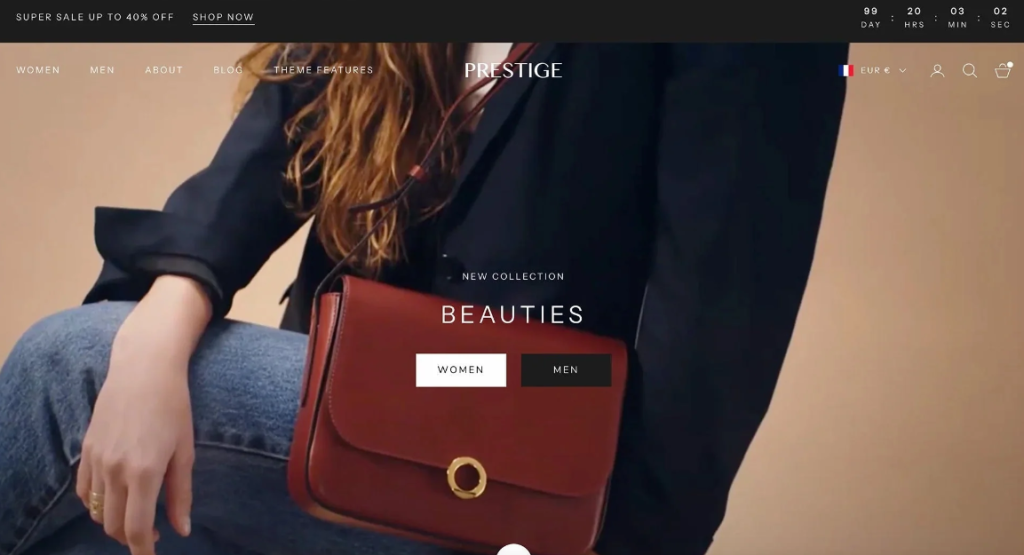
Prestige uses a clean, minimal layout that puts the full weight of the design on product photography. It is well suited to luxury and high-end clothing brands that want their pricing supported by a polished, uncluttered presentation.
- Price: $400
- Key features: 30+ customizable sections, styled photo galleries, menu structure suited to large category hierarchies
- Design style: Clean and minimal, with white space that puts full focus on product photography
- Why it works: A polished, uncluttered design supports premium pricing better than a feature-heavy layout
- Considerations: Requires strong, consistent product photography — the minimal design leaves little room to disguise weaker images
Avante
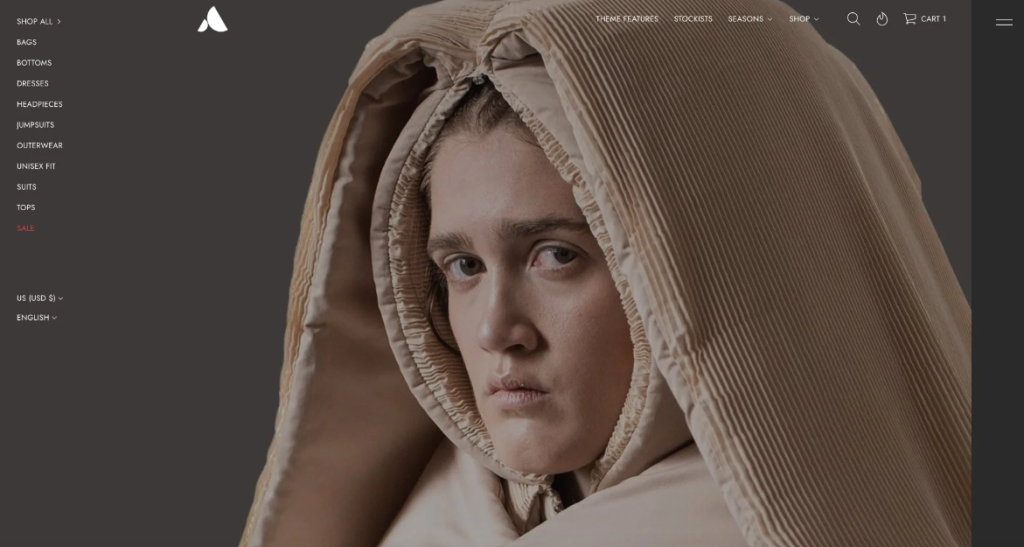
Avante is designed for boutique and women’s fashion stores with a smaller, curated catalogue rather than a large inventory. Its editorial layout is built to highlight individual products through storytelling rather than volume.
- Price: $290
- Key features: 40+ sections for photos and brand storytelling, colour swatches, variant images, and size guides included by default
- Design style: Soft, editorial layout suited to lookbook-style presentation
- Why it works: Boutiques selling limited quantities depend on customer confidence about fit; built-in size guides help reduce uncertainty
- Considerations: Not designed for large catalogues; businesses with 500+ products should consider a different theme
Motion
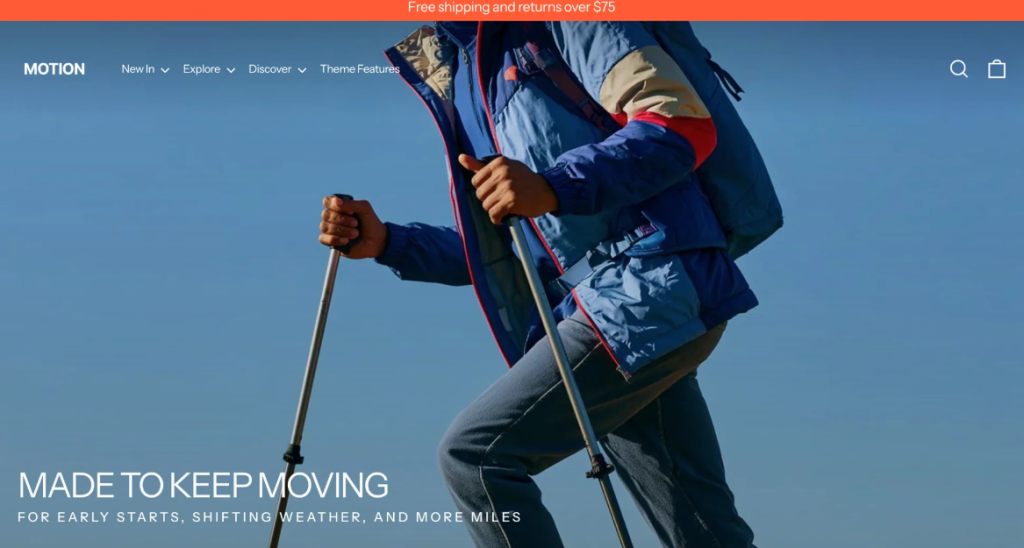
Motion brings movement and video into the browsing experience, making it well suited to streetwear and lifestyle brands built around a strong visual identity. It is designed to feel energetic rather than static.
- Price: $400
- Key features: Scroll-triggered animation, embedded video support, multiple design presets, enhanced search
- Design style: Energetic and visually dynamic rather than static
- Why it works: Supports brands that rely on visual identity and atmosphere as much as the product itself
- Considerations: Works best with high-quality product photography; should be tested with real product images before launch
Reformation
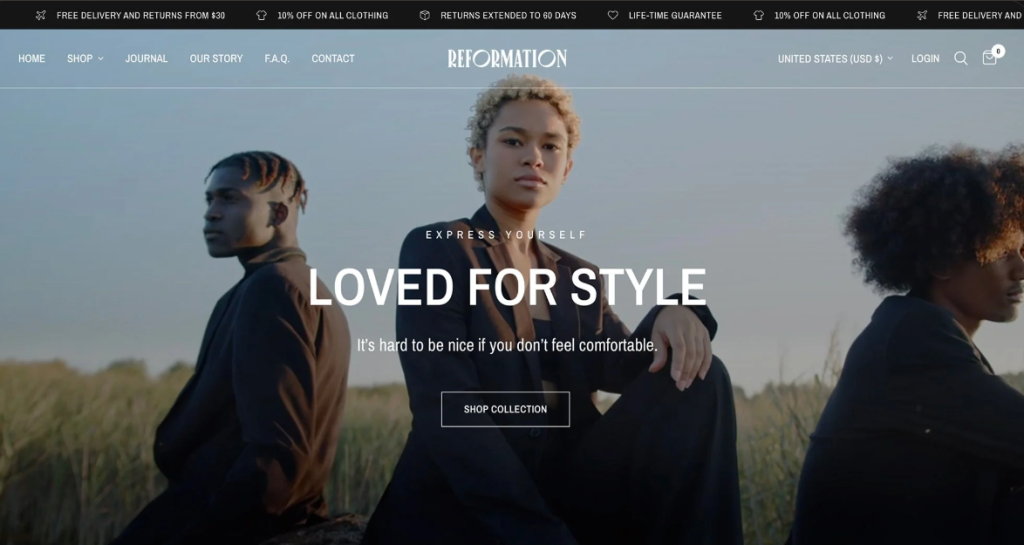
Reformation is built to stay fast and organised as a product catalogue grows into the hundreds or thousands of items. It is best suited to established retailers managing a high volume of products and frequent inventory updates.
- Price: $430
- Key features: Multiple product images on hover, cart button that stays visible while scrolling, video support in featured sections
- Design style: Clean and organised, built specifically to avoid clutter at scale
- Why it works: Built and tested for stores processing large transaction volumes and large seasonal catalogues without slowing down
- Considerations: A small number of users report slower performance when many additional apps are installed; testing with the actual catalogue before purchase is recommended
Zest
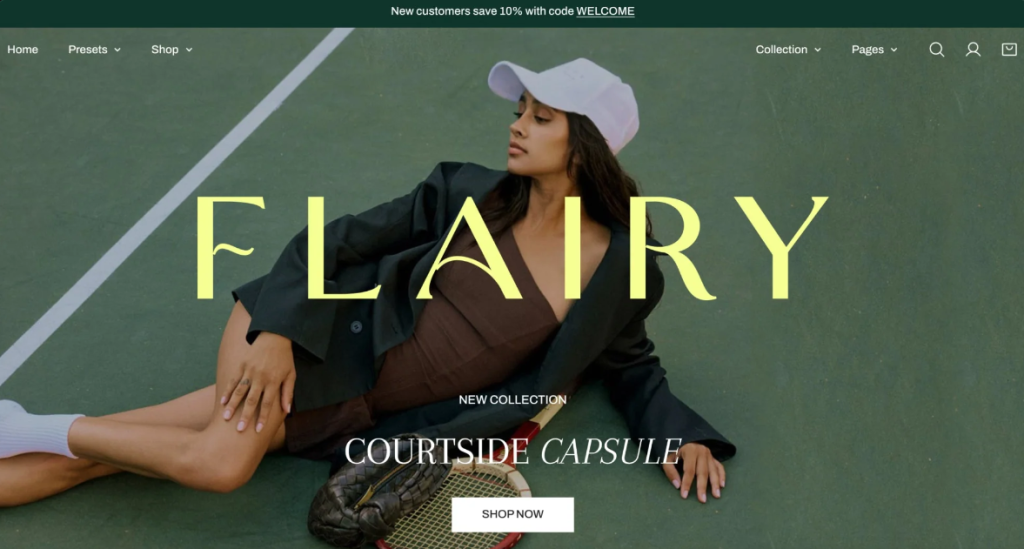
Zest is built specifically for mobile browsing rather than adapted from a desktop layout, making it well suited to direct-to-consumer brands where most customers shop from a phone. Navigation and checkout are designed for one-handed use.
- Price: $330
- Key features: Styled photo sections, zoom functionality, built-in customer reviews and testimonials
- Design style: Navigation, galleries, and checkout built specifically for one-handed mobile use, not scaled down from desktop
- Why it works: Since a large share of fashion shopping happens on mobile devices, mobile-first design directly affects completed purchases
- Considerations: Mid-range pricing; budget-focused brands may want to compare this against Blum if speed alone is the priority
Best Theme by Business Type
| Business Type | Recommended Theme | Why |
|---|---|---|
| Boutique stores | Avante | Built-in storytelling sections and size guides suit a smaller, curated catalogue |
| Luxury brands | Prestige | Minimal design supports premium pricing and strong photography |
| Streetwear | Motion | Animation and video support suit brands built on visual identity |
| Print-on-demand | Blum | Low cost and fast loading speed suit thinner profit margins |
| Large fashion retailers | Reformation | Built to stay fast and organized with a large product catalogue |
| Mobile-first DTC brands | Zest | Designed specifically for mobile browsing and checkout |
Free vs Paid Shopify Clothing Themes
| Factor | Free Themes (e.g. Dawn) | Paid Themes (e.g. Blum, Prestige, Avante) |
|---|---|---|
| Starting cost | No cost | $170 – $430, paid once |
| Clothing-specific features | Basic colour and size options | Size guides, styled photo sections, and colour swatches included |
| Sales tools | Limited; usually requires separate apps | Cart button, quick previews, and promotional tools built in |
| Design flexibility | Fewer layout options | Wider range of layouts and customization |
| Best suited for | New businesses testing an idea | Businesses ready to invest in growth and conversions |
| Long-term cost | May increase over time due to added apps | Often works out more cost-effective, as fewer apps are needed |
In short: A free theme is a reasonable way to start a business without upfront cost. However, as a store grows and requires features such as size guides, colour options, and promotional tools, a paid theme is usually more cost-effective than adding several apps to a free one.
How to Choose the Right Theme Based on Your Business Stage
- New businesses: begin with Dawn, a free theme, to test the business idea before making any investment. Move to a paid theme once monthly sales are consistent.
- Growing businesses: Blum or Zest offer strong performance at a reasonable price for businesses that are scaling steadily.
- Established brands: Avante, Motion, or Prestige provide the design depth needed once a brand identity is already established.
- Large or high-volume businesses: Reformation or Impulse are built to manage large catalogues and frequent promotions without slowing down.
Conclusion
The right Shopify theme depends less on which one looks best in a demo, and more on what the business actually needs at its current stage, including catalogue size, mobile traffic, and brand positioning. Store owners can use the comparison table, theme overview, and business-type recommendations above as a starting point and should test live demos with their own product photos before making a purchase.